Masterclass 01: Architectural Conservation and Fortification | April 2026
The recent wave of missile strikes in central Tel Aviv–Yafo over the past weeks has transformed what was once regarded as a professional concern for experts into an immediate, existential, everyday question for thousands of residents: how can we protect occupants in existing buildings—particularly heritage-listed buildings—without erasing the values that make them part of our urban identity and cultural heritage?
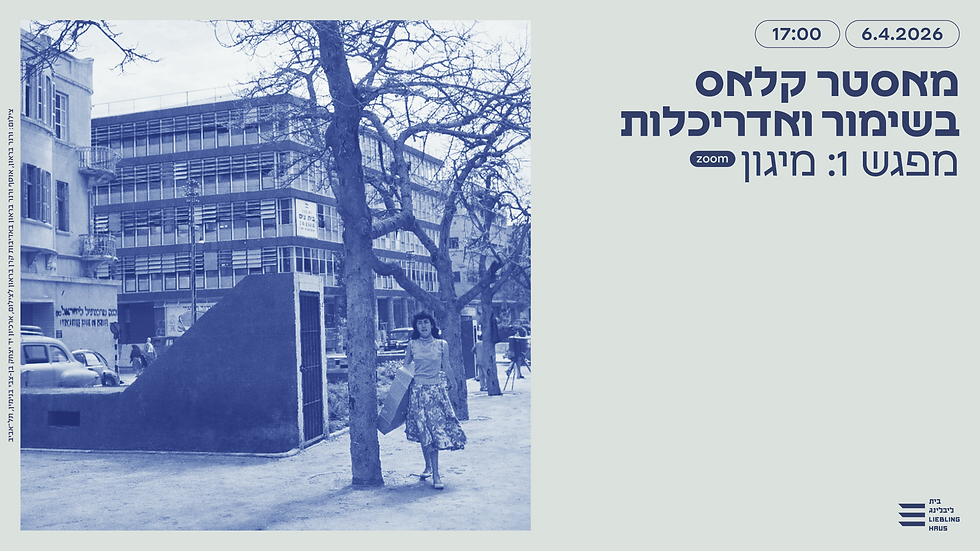
In the master class held within the Liebling Haus research lab, we addressed the inherent tension between Architectural conservation and resilience. From the outset, it was emphasized that the value of human life is paramount and takes precedence over all other considerations. Accordingly, the discussion was not about whether to intervene, but rather how such interventions can be designed to accommodate the full complexity of the urban condition.
The need to safeguard cultural heritage during periods of conflict is not new. Dr. Architect Jeremie Hoffmann, Head of the Conservation Department at the Tel Aviv–Yafo Municipality, presented the historical rationale for protecting heritage sites in wartime contexts around the world. This approach, grounded in the Hague Convention on the Laws and Customs of War—which Israel is also a signatory to—considers historic buildings an integral component of both national and international resilience. Since World War II, growing recognition of the importance of historic structures has also shaped contemporary thinking about protective solutions within dense, existing urban environments.
On a technical level, we distinguished between new construction—where protective requirements are mandated by law—and renovation or conservation projects, in which municipalities do not have the authority to require private owners to add protected spaces within existing residential units. Within these constraints, structural engineer Yaacov Schaffer, a specialist in historic buildings and conservation sites, proposed several possible fortification strategies.
Introducing protective interventions at the expense of open space, whether public or private, raises an additional dilemma, due to their impact on the continuity of the conserved urban fabric. Patrick Geddes’ Garden City plan for central Tel Aviv defines a set of relationships between built and open space, including the principle that buildings occupy no more than one-third of each plot. The remaining area ensures the penetration of light and air into each dwelling. The plan also establishes a system of green boulevards, primary and secondary streets, and small neighborhood gardens (“block gardens”) enclosed by residential buildings, rather than the closed European perimeter block. These principles collectively contribute to a high quality of life for residents over time.
In the discussion, we considered solutions that remain within the designated conservation plot boundaries, emphasizing that each case must be evaluated individually. The highest priority remains the creation of optimal protected spaces for residents of both new (as required by law) and existing dwellings.

We reviewed four main types of protective solutions currently used in heritage buildings: underground shelters, in-unit protected spaces (MAMAD), floor-level protected spaces (MAMAK), and structural reinforcement measures. These topics led to proposals for incentive-based mechanisms, such as converting main floor area into service area through its fortification. Such incentives may encourage developers, homeowners, and building associations to implement protection within the existing urban fabric.
Additionally, it was argued that the market tendency to prioritize a dedicated MAMAD for each apartment often slows down conservation or adaptive reuse processes. As a response, we heard practical proposals for innovative retrofitting methods presented by Ran Naor, CEO of ORTEC, who together with other industry actors develops solutions for reinforcing existing rooms to meet Home Front Command standards. Together, we attempted to bring into architectural discourse a deeper understanding of existing constraints and potential solutions, particularly in contexts where the creation of standardized MAMAD additions is difficult to implement.
Ultimately, the discussion on the fortification of heritage buildings brings us back to a longstanding question at the core of conservation practice: the conservation of the past is intended to secure a better future—one grounded in deeper, more resilient foundations. Yet, to conserve the past, we must at times accept its transformation, or alternatively recognize the value of the historical and human layers that have accumulated within it over time.
If fortification is understood as an additional layer in the building’s complex history, then protection and conservation need not be seen as opposing forces, but rather as interdependent dimensions. Together, they form a symbiotic system aimed at producing a city that is both vital and secure—one in which safeguarding heritage also contributes to urban resilience, without compromising the personal safety of its inhabitants.
Link to the event recording (HEBREW)


תגובות